
Technology-based CDR Potential in the Middle East (2/3)
Industrial Synergy & Geological Potential: How DAC, mineralization, and industrial processes could be uniquely scaled in the Middle East

Note: The series particularly focuses on the Gulf countries. Click the link below for the series introduction.
Following the previous article in this Middle East CDR series, which mapped the current landscape of carbon removal players and projects,

this piece explores the GCC's potential for deploying technology-based CDR solutions. Theoretical estimates are grounded in the region’s current infrastructure and publicly announced build-outs. As outlined earlier, durable, technology-based CDR approaches include BECCS, DACCS, DOCCS, Enhanced Rock Weathering, and Ocean Alkalinity Enhancement. This article assesses capture infrastructure, energy requirements, storage or utilization pathways, and geological suitability for these CDR approaches. This article will be published in 3 parts. Check the 1st part below:

Continued from the first part, we will discuss the remaining resources required to implement CDR.
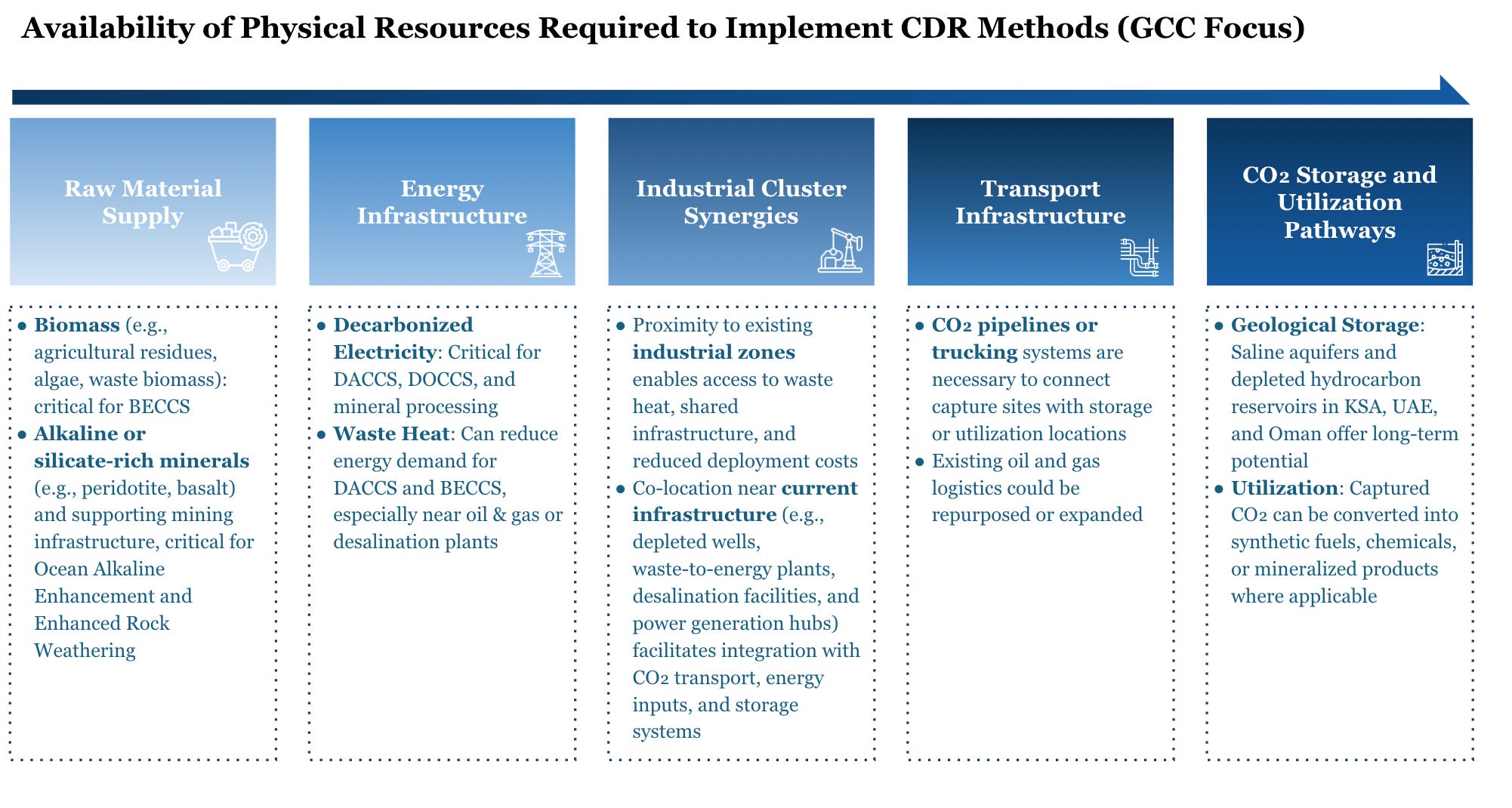
Availability of Physical Resources Required to Implement CDR Methods
Note: some data points are incomplete or estimated; figures should be treated as indicative references rather than precise metrics.
Resource B: Energy Infrastructure
B.1: Decarbonized Electricity
The maximum additional energy available for CDR is estimated by calculating the difference in clean energy production between the maximum clean energy production scenario and the current policy or baseline scenario.
Given existing and projected industrial conditions, we assume that approximately 10-20% of this surplus clean energy could be dedicated to CDR applications (e.g., DACCS, electrochemical CO₂ removal).
Note: This methodology does not account for off-grid or independently deployed distributed renewable generation.
The following is a simplified analysis for KSA based on scenario-based forecasting from KAPSARC. We assume the Net Zero 2060 scenario reflects the maximum renewable energy deployment, while the baseline scenario represents the continuation of current policy trajectories.
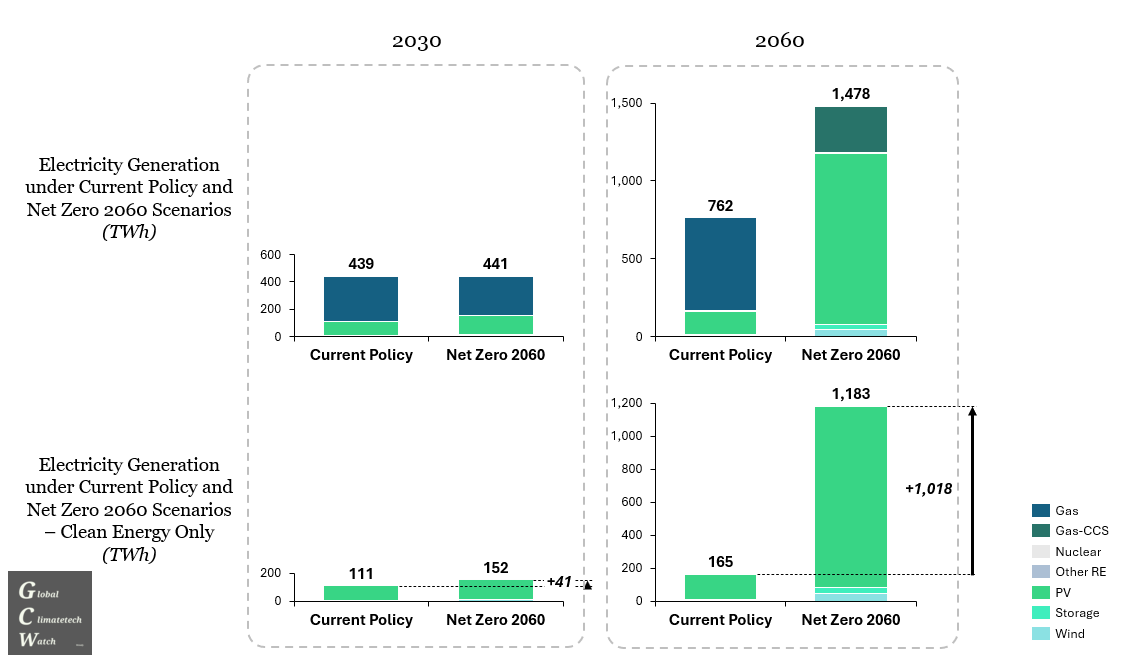
2030: Additional clean energy available in KSA = +41 TWh
Additional clean energy available for CDR in KSA: 4-6 TWh
2060: Additional clean energy available in KSA = +1,018 TWh
Additional clean energy available for CDR in KSA: 100-150 TWh
It is challenging to obtain detailed, scenario-based breakdowns of renewable electricity generation across the UAE and other GCC countries. However, future potential can be reasonably approximated based on publicly announced deployment plans and project pipelines, with Saudi Arabia currently showing the largest capacity upside among its regional peers. For the purpose of this analysis, we assume that the total additional clean energy available for CDR across the GCC will amount to approximately 125% of Saudi Arabia’s projected figure.
2030: Additional clean energy available for CDR in GCC: 5-7.5 TWh
2060: Additional clean energy available for CDR in GCC: 125-187.5 TWh
B.2: Waste Heat
One of the key resource advantages for scaling tech-based CDR in the Gulf is the region’s abundant industrial waste heat, especially in high-temperature sectors like oil & gas, refining, and heavy industry. Strategic co-location with these industries can drastically reduce energy input costs and make GCC-hosted DACCS economically viable.
Solid sorbent DACCS (S-DACCS) requires medium-grade heat above 100°C for sorbent regeneration, making it uniquely suited to leverage industrial waste heat in the GCC. While not all waste heat qualifies, a significant portion from sectors like oil & gas, cement, and metals meets this threshold.
Liquid solvent DACCS (L-DACCS), by contrast, typically operates with low-grade heat (<100°C). In the GCC, much of the available waste heat exceeds this range and would require adaptation or dissipation to be usable, making L-DACCS less compatible with the region's thermal profile.
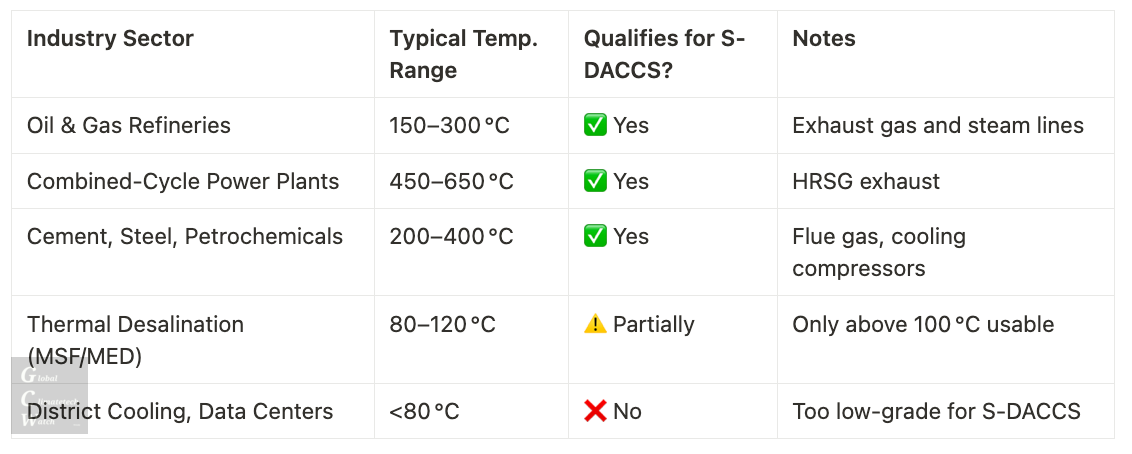
Waste Heat Sources in the GCC
1. Oil & Gas Sector
Flaring | 500–1,000°C
What it is: Excess gas is burned at wellheads or processing plants to relieve pressure.
Use for DACCS: High-grade heat, but usually dispersed; could be captured near flaring sites if co-located with DACCS units.
Refineries & Petrochemicals | 150–400°C
What it is: Processes like distillation, cracking, and reforming emit large volumes of mid- to high-grade waste heat.
Use for DACCS: Ideal source for S-DACCS; refineries also emit pure CO₂ streams, making them strong industrial symbiosis sites.
Gas Turbines (Power/Desalination) | 400–600°C
What it is: Exhaust from combined-cycle gas turbines in power and desalination.
Use for DACCS: Readily usable for S-DACCS—especially with waste heat recovery systems or co-location.
2. Cement Industry
Kiln Exhaust | 300–400°C
What it is: Cement kilns require extremely high operating temperatures (~1,450°C), and ~30–40% of the heat is lost through exhaust gases.
Use for DACCS: Waste heat is highly suitable for solid sorbent DACCS regeneration. Co-location might be feasible.
3. Metals Sector
Aluminum Smelting | 400–800°C
What it is: Electrolytic reduction of alumina emits high heat via flue gas and thermal losses.
Use for DACCS: Excellent candidate for S-DACCS; major industrial emitter with concentrated heat sources.
Steel Production | 200–600°C
What it is: Electric arc or basic oxygen furnaces generate massive thermal loads.
Use for DACCS: Mid-grade waste heat can power DACCS units if retrofitted for heat recovery.
4. Desalination (Thermal: MSF/MED)
Brine/Steam Discharge | 80–150°C
What it is: Thermal desalination relies on evaporating seawater, generating significant waste heat during condensation.
Use for DACCS: Only partial overlap—upper temperature range (>100°C) is useful for S-DACCS; low-grade heat may be suited for liquid solvent DAC or other uses.
The total volume of usable waste heat in the GCC is difficult to estimate due to limited public data and variations in heat quality and recoverability. While formal frameworks for waste heat recovery are still in early stages, flagship projects like ADNOC’s Waste Heat Recovery initiative in Ruwais offer valuable benchmarks. The plant captures 230 MW of thermal energy, generating roughly 2 TWh/year of additional electricity. This project showcases the potential of high-grade heat recovery—particularly relevant for solid sorbent DACCS systems that require temperatures above 100 °C.
Resource C: Industrial Cluster Synergies
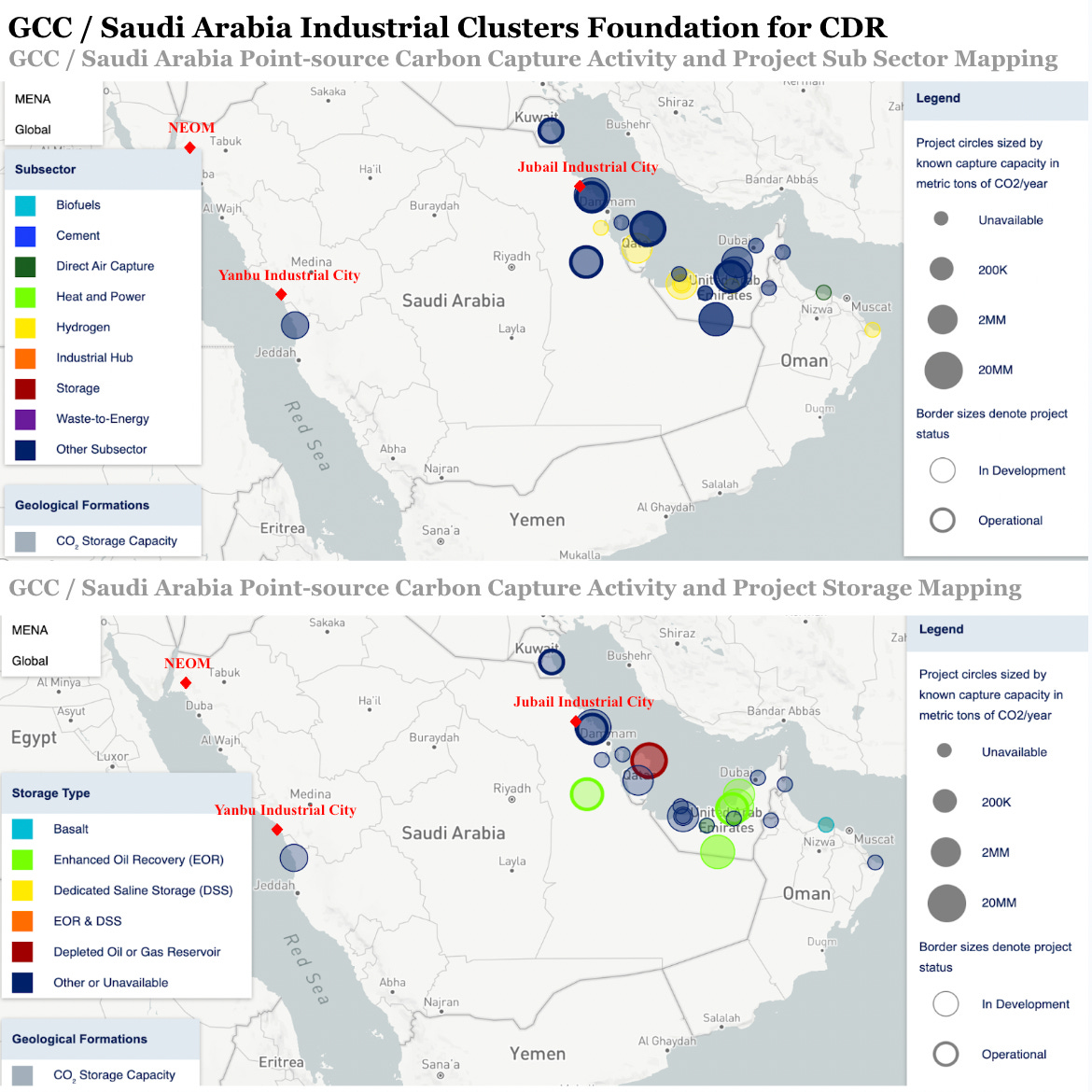
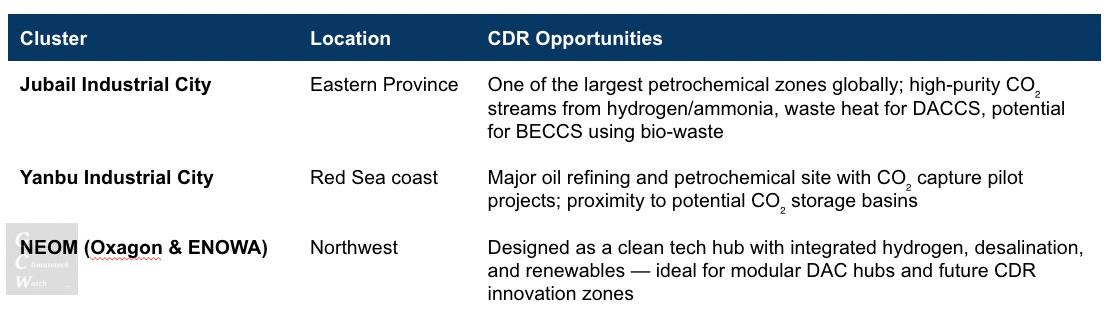
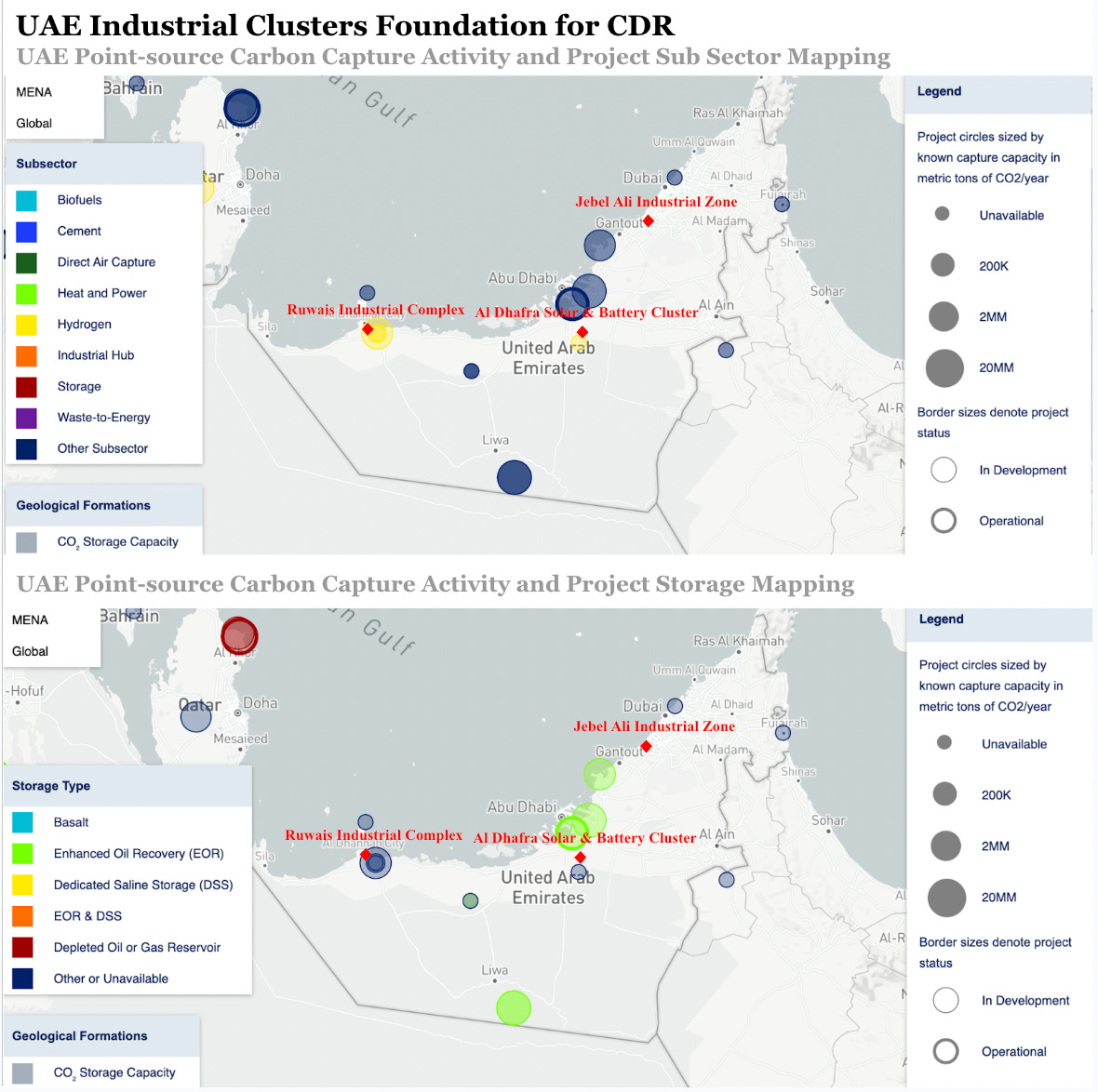
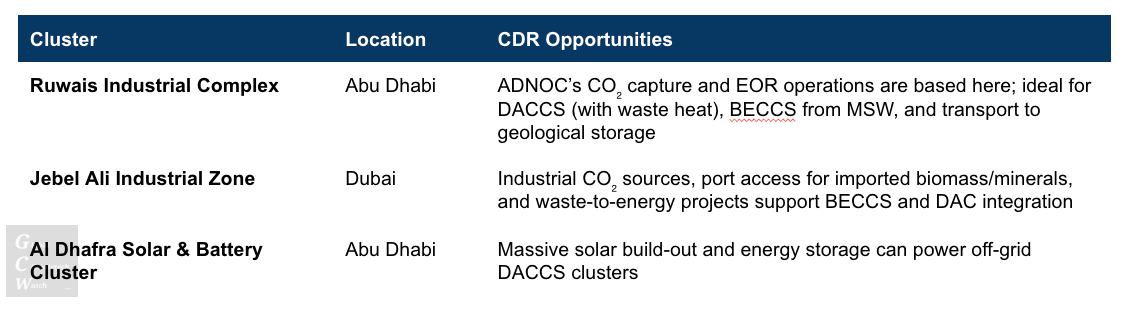
In the GCC, point source emissions are heavily concentrated along the Gulf, particularly from the power and oil & gas sectors, with additional clusters around major urban centers like Riyadh and Jeddah. In contrast, cement plant emissions are more geographically dispersed. Strategically co-locating CDR technologies—such as DACCS, BECCS, and DOCCS—near these emission hubs enables infrastructure sharing and waste heat utilization.
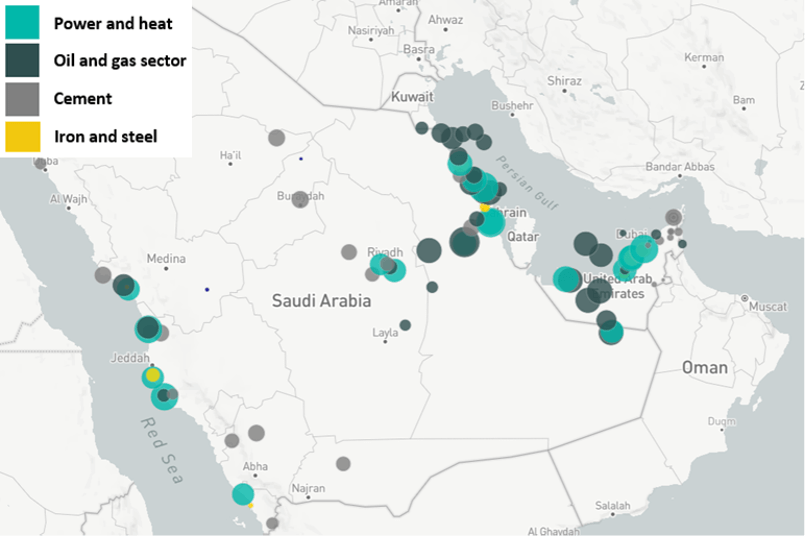
What Makes Industrial Clusters Suitable for CDR?
High-Purity CO₂ Streams
Source: Hydrogen production, ammonia plants, LNG processing, and ethylene cracking often emit >90% pure CO₂, which reduces the cost and complexity of carbon capture compared to dilute flue gases.
CDR Application: While not atmospheric in origin, these point-source CO₂ streams can complement DACCS or BECCS operations by enabling hybrid hubs where DACCS, BECCS, and point-source CCS co-locate and share infrastructure.
Abundant Waste Heat
Source: Refineries, LNG liquefaction, steel mills, and desalination plants produce significant quantities of waste heat above 100°C, often vented unused.
CDR Application: Solid-sorbent DACCS requires thermal input (~100–120°C); co-locating DAC systems with these clusters allows low-cost integration of waste heat.
Desalination Infrastructure
Source: The GCC hosts some of the world’s largest thermal (MSF/MED) and reverse osmosis (RO) desalination facilities, especially in the UAE, Saudi Arabia, and Qatar.
CDR Application:
Algal BECCS: Brine or treated water from desalination plants can support algae cultivation for biomass-based CDR.
Ocean CDR: Coastal infrastructure and brine discharge systems can be leveraged for electrochemical ocean carbon removal or alkalinity enhancement.
Proximity to Geological Storage
Geological Storage: Many industrial zones are within reach of saline aquifers or depleted oil/gas reservoirs (e.g., Bab field in UAE, Ghawar in KSA), suitable for permanent CO₂ sequestration.
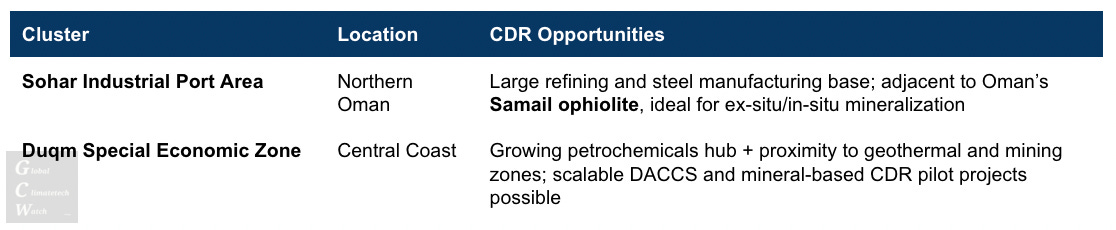
Ophiolite Access: In Oman, industrial ports like Sohar are directly adjacent to ultramafic rock formations, enabling ex-situ or in-situ mineralization with reduced transport needs.
Existing Pipeline and CO₂ Logistics Infrastructure
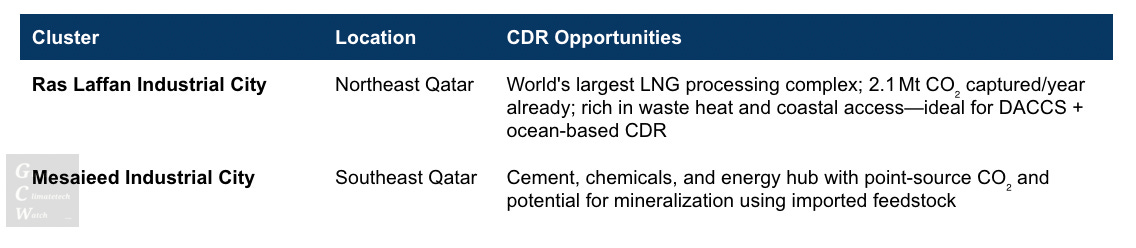
Source: Regions like Ruwais (UAE), Ras Laffan (Qatar), and Jubail (KSA) already have CO₂ pipelines or ready-to-repurpose oil & gas infrastructure.
CDR Application: These networks can be adapted for captured CO₂ transport, reducing the need for new investment and accelerating hub-based CDR deployment.
Major Industrial Clusters Suitable for CDR in the GCC
🇸🇦 Saudi Arabia
🇦🇪 UAE
🇴🇲 Oman
🇶🇦 Qatar
Resource D: Transport Infrastructure
Repurposed infrastructure: Redundant oil & gas pipelines and tanker logistics can be adapted for CO₂ transport, with ADNOC, Aramco, and QatarEnergy already expanding dedicated CCUS pipeline networks.
Emerging CO₂ hubs across the UAE, KSA, Qatar, and Oman aim to link multiple emission sources to storage or utilization sites, enabling efficient aggregation and scale.
Proximity to storage or usage sites is critical to minimize transport costs, leakage risks, and infrastructure requirements, making geographic clustering a key design principle in GCC CDR development.
Resource E: CO₂ Storage and Utilization
E.1: Geological Storage
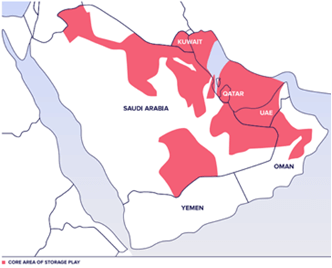
The GCC region has substantial geological storage potential for CO₂, particularly in depleted oil and gas reservoirs, saline aquifers, and the Oman ophiolite. Across 11 sedimentary sequences, the Rub’ al-Khali basin stands out for its high storage density and diversity of reservoir types, while Kuwait also hosts significant capacity. Optimal storage conditions are found in well-sealed sandstones and shallow carbonates with established reservoir trends, whereas deeper, tighter carbonates present challenges due to uncertain injectivity and reservoir distribution. The Oman ophiolite offers a promising but still uncertain pathway for in-situ mineralization, with large theoretical volumes that require further exploration and validation.
According to current assessments, the best-case total storage capacity in GCC saline aquifers and ophiolite zones is estimated at 127.5 Gt of CO₂, with an additional 41.5 Gt in depleted gas fields—together offering over 230 years of storage at current emission levels (Afry report). This positions the GCC as technically competitive with other leading global regions in terms of geological storage potential. However, to realize this advantage, detailed site-level studies are needed to delineate viable injection zones, confirm reservoir performance, and reduce risks associated with long-term carbon sequestration.
An interesting quote describing the potential of geological storage in the region:
“Hasan thinks 44.01 could one day mineralize 1.3 billion tons of CO2 annually in Oman’s mantle formation. Sequestering a billion tons of CO2 a year in Oman would require massive infrastructure. Kelemen has calculated that if the gas were concentrated to 440 times what naturally occurs in seawater—which can readily be done by today’s air-capture machines—5,000 injection wells would be needed. Together they would pump a combined 23 cubic kilometers of water a year—about 4 percent of the flow of the Mississippi River.”
-- 44.01’s founder, Talal Hasan
E.2: Utilization
CO₂-to-products applications are emerging in sectors such as synthetic fuels, construction materials, and chemicals:
Synthetic Fuels: Captured CO₂ can be combined with green hydrogen (via electrolysis) to produce e-methanol or other synthetic hydrocarbons for sustainable aviation fuel (SAF) and green shipping fuels.
NEOM (KSA): The Helios Green Fuels Project aims to produce e-methanol and e-kerosene using green hydrogen and captured CO₂. It targets exports for aviation and shipping fuel markets.
Mineralization: CO₂ can be permanently stored by reacting it with alkaline industrial residues (e.g., cement kiln dust, steel slag) to form stable carbonates used in construction.
Bee'ah (UAE): Municipal solid waste management firm exploring CO₂ use in concrete and construction materials through mineral carbonation.
Industrial Chemicals: CO₂ is being explored as a feedstock for methanol and polymers, with integration opportunities in existing petrochemical and ammonia plants across the GCC.
QAFCO (Qatar): The Qatar Fertilizer Company captures CO₂ from its ammonia plants and reuses it to produce urea, integrating carbon utilization into the chemicals value chain.
Aramco (KSA): Actively researching CO₂ conversion into polymers and methanol, including in collaboration with SABIC and global tech providers.
Conclusion
With this piece concluding the resource landscape for CDR in the GCC, the region clearly holds significant potential: abundant raw materials, emerging clean energy capacity, large volumes of waste heat, dense industrial clusters, and substantial geological storage. These physical and infrastructural advantages position the Gulf as a possible leader in scaling technology-based carbon removal.
Yet, alongside this promise lie substantial challenges—including ambitious industrial targets that may underdeliver, limited government incentives to prioritize CDR infrastructure, and corporate strategic objectives that often lack clear pathways for collaboration and innovation with CDR. Add to this the persistent uncertainties around financing mechanisms and the absence of robust MRV systems, and the gap between potential and practice becomes clear.
In the final piece of this tech-based CDR series, we will summarize resource availability and gaps for each pathway, and outline a prioritization roadmap.
Author’s Word: There has been limited research conducted in this space overall—let alone studies focused specifically on the Middle East. My analysis approaches the topic from an academic lens, but given the current state of knowledge and data availability, much of it remains at a surface level. I'm especially grateful for Carbon Gap’s Carbon Removal Readiness Assessment Initiative, which provided valuable methodological frameworks that I was able to reference and adapt throughout this exercise. A lot of the calculations in this article are based on a lot of assumptions, and more detailed analysis should be further explored if to make any statements.
Sources:
MENA Carbon Capture Activity and Project Map: https://www.catf.us/ccsmapmena/
Global CCS Institute 2022, 2023, 2024 Report. https://status22.globalccsinstitute.com/2022-status-report/regional-overview/
Carbon Gap - Carbon Removal Readiness Assessment Initiative
https://www.kapsarc.org/research/publications/challenges-and-opportunities-for-sustainable-deployment-of-bioenergy-with-carbon-capture-and-storage-pathways-beccs-globally/