
Technology-based CDR Potential in the Middle East (1/3)
Industrial Synergy & Geological Potential: How DAC, mineralization, and industrial processes could be uniquely scaled in the Middle East

Note: The series particularly focuses on the Gulf countries. This is the second article of this series. Click the link below for the series introduction.

Following the previous article in this Middle East CDR series, which mapped the current landscape of carbon removal players and projects,

this piece explores the GCC's potential for deploying technology-based CDR solutions. Theoretical estimates are grounded in the region’s current infrastructure and publicly announced build-outs. As outlined earlier, durable, technology-based CDR approaches include BECCS, DACCS, DOCCS, Enhanced Rock Weathering, and Ocean Alkalinity Enhancement. This article assesses capture infrastructure, energy requirements, storage or utilization pathways, and geological suitability for these CDR approaches. This article will be published in 3 parts.
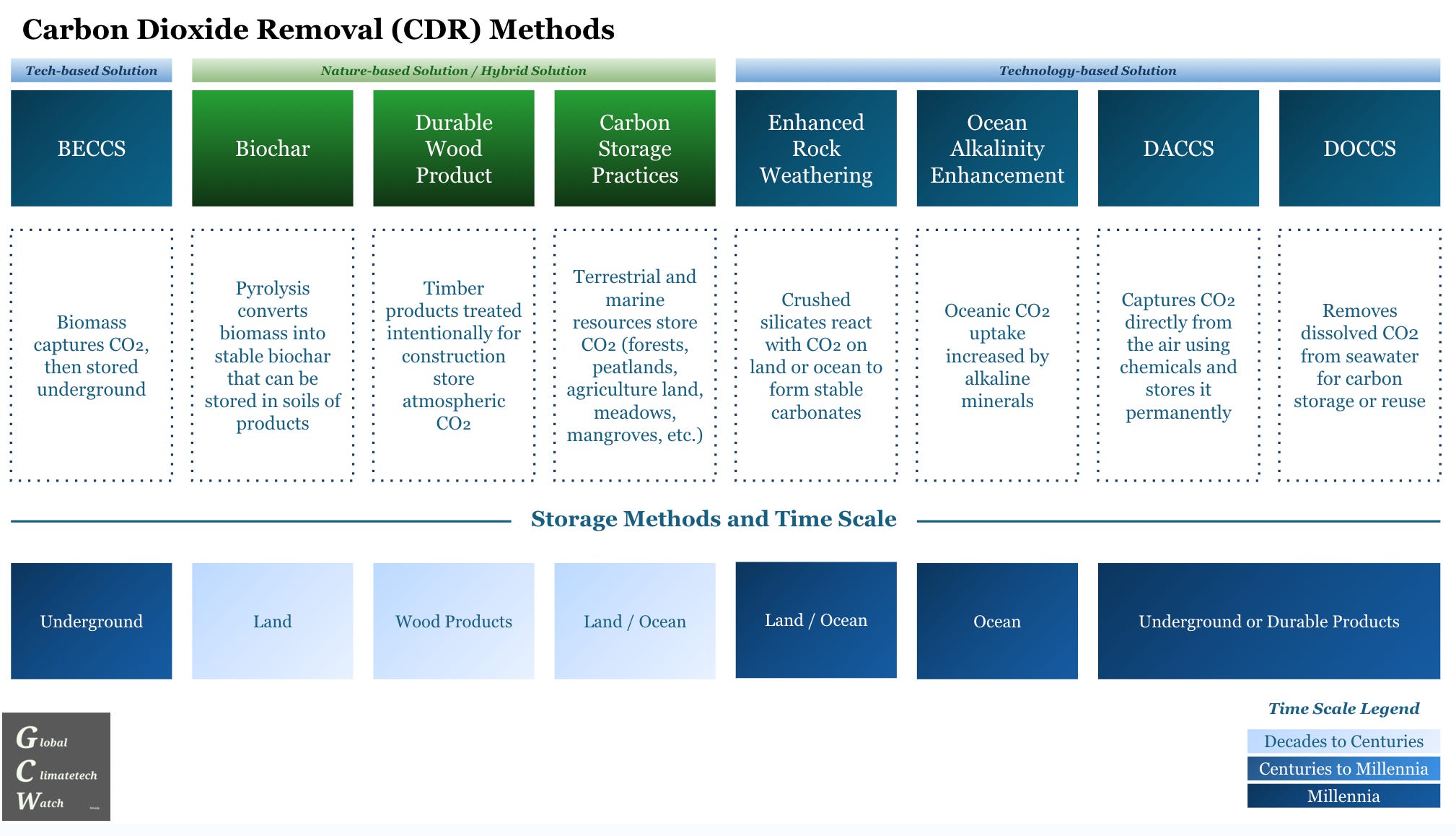
For each technology-based CDR pathway, there are distinct critical actors, infrastructure dependencies, and enabling conditions required for successful deployment. In the sections below, I briefly outline these prerequisites for each pathway and provide a consolidated summary at the end.
Introduction of Prerequisites for Each Tech-based CDR Approach
1. BECCS
Biomass combustion with CO₂ capture and geological storage
Biomass Supply: Requires sustainable domestic sources or imports (e.g., date palm residue, algae, agricultural waste).
Energy Use: Not energy-intensive, but decarbonized power improves net removal efficiency.
Industrial Integration: Suited for bioenergy plants or co-firing in existing industrial facilities.
Waste Heat: Can enhance process efficiency.
CCS Infrastructure: Requires capture units (post-combustion), compression systems, and access to CO₂ storage sites (e.g., saline aquifers, depleted reservoirs).
CO₂ Transport & Storage: Requires pipeline or trucking infrastructure to access geological storage.
Deployment Strategy: Best situated within industrial clusters to share CO₂ handling infrastructure.
2. DACCS
Captures CO₂ from ambient air and stores it underground or in durable products
Energy Use: High — demands decarbonized electricity or industrial waste heat (e.g., from oil & gas or desalination).
Technology Components: Air contactors, sorbents, regenerators, compression systems.
Industrial Integration: Ideal near renewable energy zones or co-located with industrial plants for energy synergies.
CO₂ Transport & Storage: Requires infrastructure for compression and delivery to geological storage.
Utilization Potential: Mineralization or conversion into synthetic fuels when storage is unavailable.
3. DOCCS
Electrochemically removes CO₂ from seawater
Energy Use: Requires low-carbon electricity; can be integrated with marine energy systems or coastal renewables.
Technology Requirements: Electrochemical cells, membrane units, brine management.
Coastal Integration: Best deployed near desalination plants or marine infrastructure.
CO₂ Handling: Captured CO₂ can be transported to geological storage or reused in industrial processes.
Utilization Pathways: Potential for fuels, chemicals, or carbonates.
4. Ocean Alkalinity Enhancement
Adds alkaline materials to seawater to enhance CO₂ uptake
Feedstock Access: Relies on natural silicate deposits or alkaline industrial byproducts (e.g., cement kiln dust, slag).
Processing Needs: Mining, crushing, and fine grinding of minerals.
Energy Use: Moderate; renewables preferred for grinding and transport.
Deployment Context: Requires coastal access for dispersal into ocean zones.
Industrial Synergies: Potential co-location with cement, mining, or steel facilities.
CO₂ Storage: No geological storage needed — CO₂ is passively sequestered in the ocean.
5. Enhanced Rock Weathering
Engineered spreading of crushed silicate rocks on land/ocean
Feedstock Availability: Abundant in Oman, UAE, and parts of Saudi Arabia (e.g., peridotite, dunite).
Infrastructure Needs: Mining, crushing, and logistics for distribution.
Energy Use: Moderate; requires decarbonized electricity for material preparation.
Deployment Zones: Arable land, desert surfaces, or coastal regions.
Industrial Integration: Can link with construction, mining, or agriculture sectors.
CO₂ Storage: Permanently stored via in-situ mineralization in soils or nearshore zones.
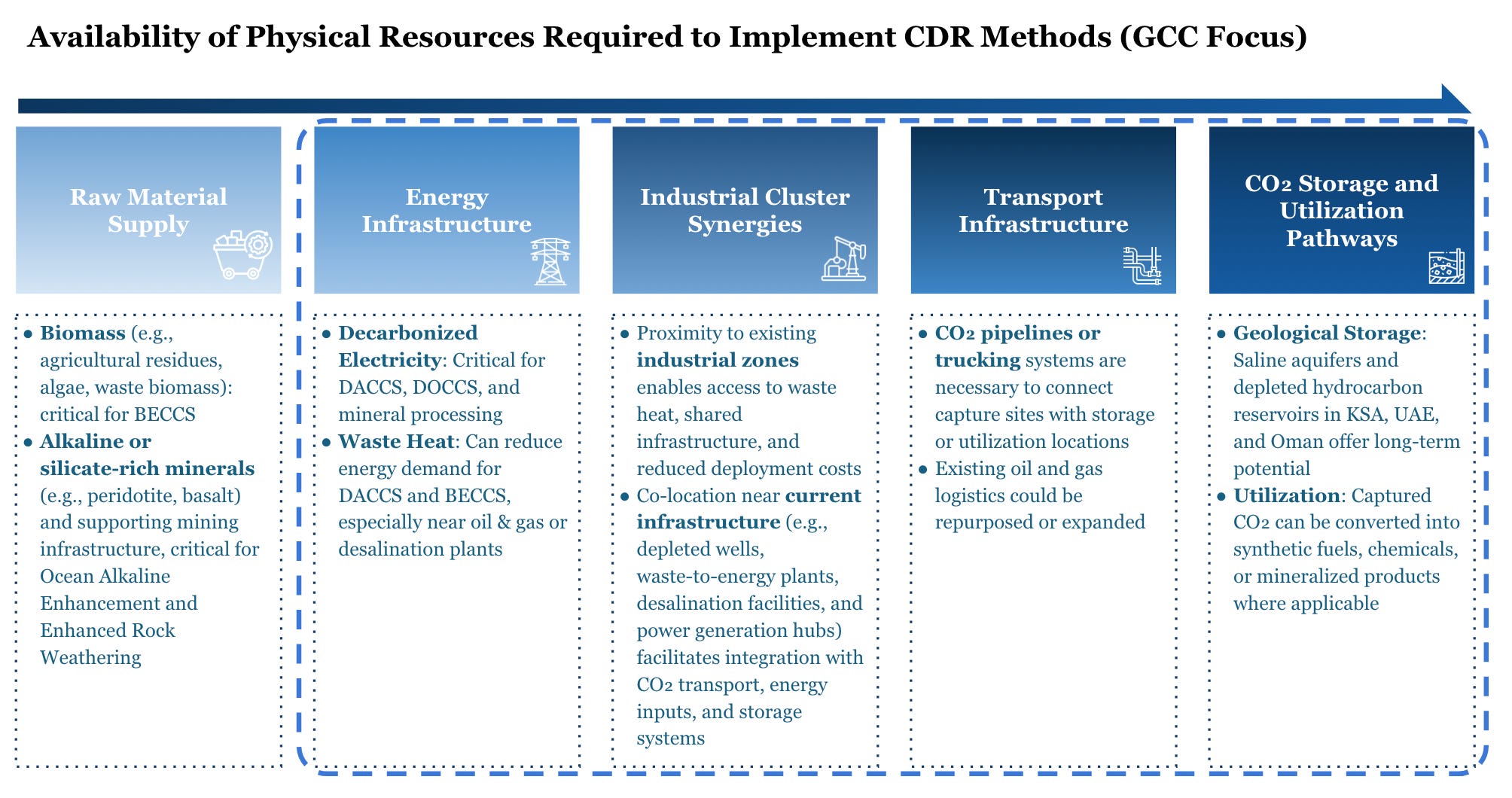
Based on the specific prerequisites of each technology-based CDR approach, I have summarized five key resources essential for enabling CDR deployment in the GCC.
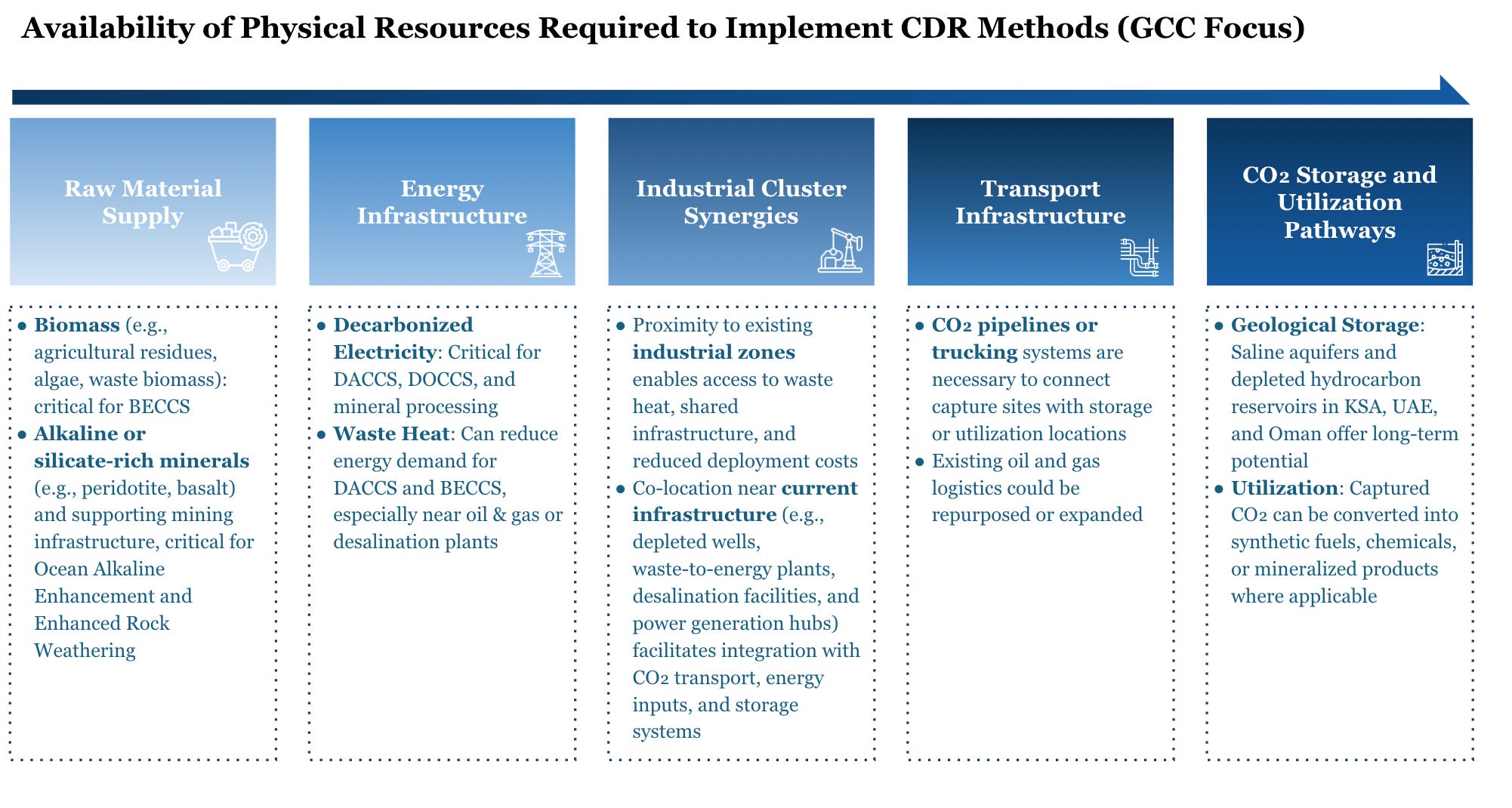
Availability of Physical Resources Required to Implement CDR Methods
Raw Material Supply: Biomass, alkaline or silicate minerals
Energy Infrastructure: Decarbonized electricity, waste heat
Industrial Cluster Synergies: Industrial clusters, industrial infrastructure
Transport Infrastructure: CO₂ pipelines or trucking systems
CO₂ Storage and Utilization Pathways: Geological storage, utilization
Below, I detail each key prerequisite and assess the current and projected availability of relevant resources in the GCC.
Note: some data points are incomplete or estimated; figures should be treated as indicative references rather than precise metrics.
Resource A: Raw Material Supply
A.1: Biomass Feedstocks in the Middle East/GCC
Based on regional data and project developments, the primary biomass sources for CDR in the GCC are:
1. Agricultural Residues
Date Palm Waste: Dominant in date-producing nations (Saudi Arabia, UAE, Oman), with >200,000 tonnes/year generated in KSA alone. This includes fronds, pits, and prunings, offering high cellulose content for thermochemical conversion.
Animal Wastes: Largely underutilized and available for anaerobic digestion.
2. Algae Cultivation
Feasible via wastewater integration near coastal desalination/industrial plants, though commercial scaling remains limited by high operational costs.
3. Municipal Solid Waste (MSW)
Constraints on Other Feedstocks
Forest Biomass: Negligible due to minimal forest cover (<5% GCC land area).
Agri-Food Co-Products: Limited by regional food supply chains; prioritization for human/animal consumption reduces CDR availability.
Future Outlook: Biomass Availability by 2030 and Beyond
Growth Multiplier Assumption:
Based on rising waste generation, agricultural scaling (particularly in controlled environment agriculture), and enhanced waste segregation policies, it's reasonable to assume a 1.5x to 2x increase in usable biomass by 2030 compared to 2019 levels.
New Biomass Streams May Emerge:
Energy crops on treated wastewater
Integrated food–energy systems using saline or marginal land
Advanced bio-refinery residues
Below includes an analysis of available biomass feedstock for CDR based on 2019 data.
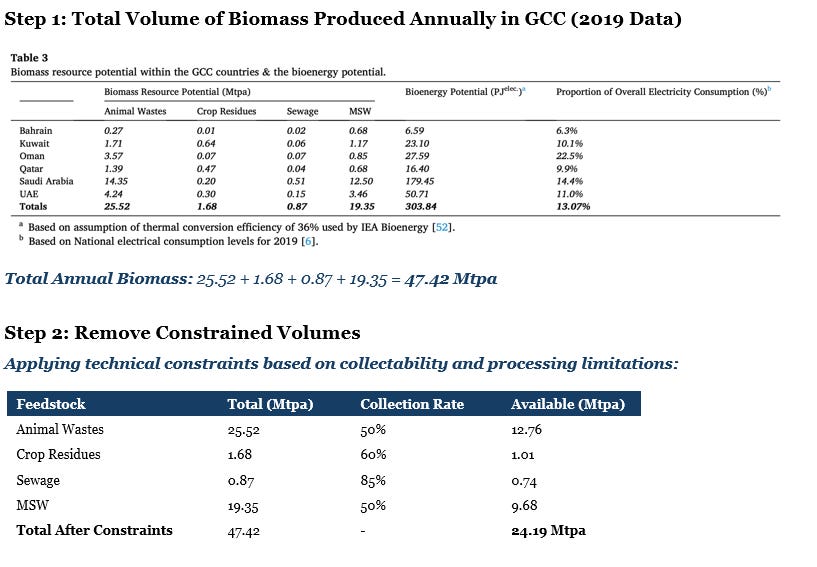
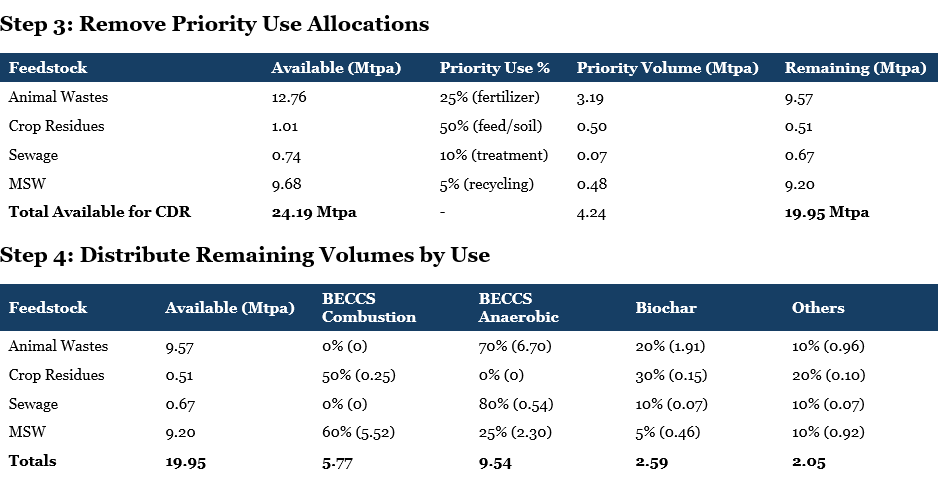
CDR-Relevant Technologies:
BECCS (Combustion): 5.77 Mtpa
BECCS (Anaerobic Digestion): 9.54 Mtpa
Biochar: 2.59 Mtpa
A.2: Alkaline or Silicate Minerals (not Geological Storage)
Basalt:
Saudi Arabia possesses extensive basalt deposits within its western volcanic belts, with a mining sector valued at $1.3 trillion, yet current basalt consumption (~30,000 tonnes/year measured in 2022) remains focused on construction, leaving significant potential to redirect fines and crushed material for enhanced weathering-based CO₂ removal.
UAE hosts the Middle East’s largest basalt fiber facility in Fujairah, producing 12,000 tonnes/year of industrial basalt products, and with coastal access and established crushing infrastructure, it is well-positioned to scale basalt-based CDR via ocean alkalinity enhancement or land application.
Limestone:
Saudi Arabia maintains a significant limestone sector, with limestone production increasing by over 300% in 2020. According to the USGS 2022 Mineral Commodity Summary, the country produced approximately 50 million tonnes of limestone for cement alone, underscoring its strong potential for industrial lime applications and enhanced weathering-based CDR pathways.
While most limestone and dolomite in the UAE are currently used as low-value construction aggregates, geologic surveys have identified high-purity limestone deposits suitable for industrial applications, opening pathways for mineral-based carbon sequestration.
Olivine (Ophiolite):
The Samail Ophiolite (Oman/UAE) spans 100,000 km² and contains ~14,700 km³ of olivine-rich peridotite. Natural weathering captures 10⁴+ tonnes CO₂/year, while enhanced methods (e.g., grinding, fluid injection) could scale this 100–1,000×. Beyond the key minerals already discussed, the GCC region also extracts dolomite, marble, schist, scoria, and other industrial rocks according to the USGS survey; while these materials are primarily used in construction and manufacturing, no comprehensive assessments have yet been conducted on their potential application in CDR pathways, such as mineral carbonation or enhanced weathering.
Stay tuned for the rest of the resources available in the GCC for CDR development in the second and third part of the article (Energy Infrastructure, Industrial Cluster Synergies, Transport Infrastructure, Storage and Utilization).
Author’s Word: There has been limited research conducted in this space overall—let alone studies focused specifically on the Middle East. My analysis approaches the topic from an academic lens, but given the current state of knowledge and data availability, much of it remains at a surface level. I'm especially grateful for Carbon Gap’s Carbon Removal Readiness Assessment Initiative, which provided valuable methodological frameworks that I was able to reference and adapt throughout this exercise.
Sources:
Carbon Gap - Carbon Removal Readiness Assessment Initiative
Welfle, A., & Alawadhi, A. (2021). Bioenergy opportunities, barriers and challenges in the Arabian Peninsula – Resource modelling, surveys & interviews. Biomass and Bioenergy, 150, vp. https://doi.org/10.1016/j.biombioe.2021.106083
https://www.kapsarc.org/research/publications/challenges-and-opportunities-for-sustainable-deployment-of-bioenergy-with-carbon-capture-and-storage-pathways-beccs-globally/
https://www.zawya.com/en/business/energy/fujairah-ruler-opens-regions-largest-basalt-fibre-facility-khmdtm6r
https://www.globalhighways.com/wh2/products/saudi-arabia-limestone-production-boost
USGS 2022 Mineral Yearbook: https://pubs.usgs.gov/myb/vol3/2022/myb3-2022-saudi-arabia.pdf
https://www.ecomena.org/biomass-resources-in-middle-east/