

Note: The series primarily focuses on the Gulf countries.
This three-part series explores the GCC’s potential to scale technology-based CDR—including BECCS, DACCS, DOCCS, Enhanced Weathering, and Ocean Alkalinity Enhancement. Grounded in existing infrastructure and announced plans, it assesses capture systems, energy inputs, and geological fit. Parts 1 and 2 covered current availability (e.g., clean electricity, waste heat). Read Part 2 here:

As we finalize our analysis of the region’s resource base, this final part summarizes the feasibility of each technology-based CDR pathway and proposes a merit order for prioritization. I will start with a consolidated overview of all key resources assessed in Parts 1 and 2:
A. Raw Materials
A.1. Biomass
~20 Mt/year potentially available after priority uses (MSW, animal waste dominate)
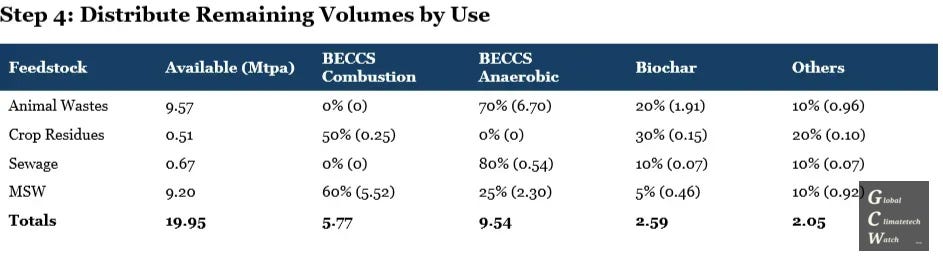
CDR Pathways from Biomass (estimated potential based on current availability):
BECCS (Combustion): 5.77 Mtpa
BECCS (Anaerobic Digestion): 9.54 Mtpa
Biochar: 2.59 Mtpa
A.2. Alkaline & Silicate Minerals
🪨 Limestone
Current output: ~50 Mt/year (KSA, mostly for cement)
CDR potential:
2030: ~1 Mt/year redirected to EW (~2% of current use)
2060: ~2.5 Mt/year with optimized use (~5%)
🪨 Basalt
Current use:
UAE’s Fujairah basalt fiber facility produces ~12 kt/year.
KSA uses ~30 kt/year of basalt for construction
Assumptions for CDR scale-up:
2030: ~30 kt/year (pilot scale only, if 1–2 pilot alkalinity enhancement projects are launched)
2060: ~0.1 Mt/year with dedicated processing
🪨 Peridotite (Olivine)
Massive reserves in Oman’s Samail Ophiolite (~15,000 km³)
Long-term potential for in-situ or ex-situ mineralization is extremely high, but:
Deployment is limited in the near term by terrain access, grinding infrastructure, and logistics
Estimated CDR potential (rough):
2030: ~0.1 Mt/year (pilot)
2060: ~5 Mt/year (conservative, assuming new infrastructure)
B. Clean Energy & Waste Heat
⚡️ B.1. Projected GCC clean energy available for CDR:
2030: Additional clean energy available for CDR in GCC: 5-7.5 TWh
Adjusted for reasonable clean energy available for CDR: ~2.5 TWh
2060: Additional clean energy available for CDR in GCC: 125-187.5 TWh
Adjusted for reasonable clean energy available for CDR: ~65 TWh
🔥 B.2. Industrial Waste Heat
Key sectors: Oil & gas, cement, aluminum, steel, and thermal desalination.
Globally, an estimated ~3,100 TWh_th/year of unused industrial waste heat is available (McKinsey, 2023).
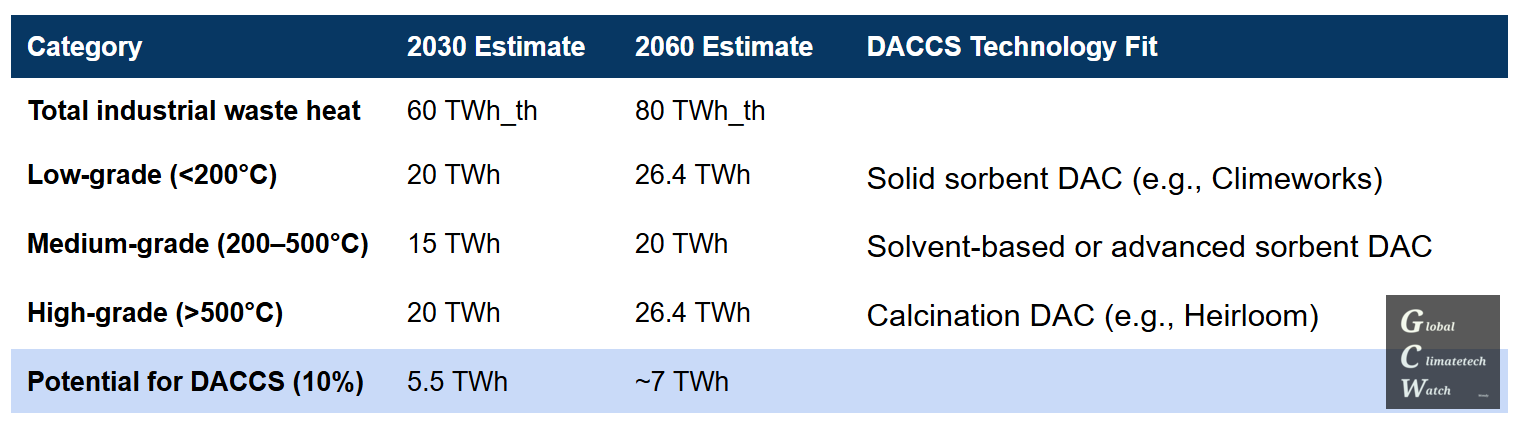
Assuming the GCC holds ~2% of global industrial activity, this translates to ~60 TWh_th/year of industrial waste heat potential in the region by 2030, increasing to ~80 TWh_th/year by 2060 due to industrial expansion and improved heat recovery.
Temperature Breakdown and DACCS Applicability
Low-grade (<200°C) — 33%, Suitable for low-temp solid sorbent DACCS (e.g., Climeworks, Carbon Infinity)
Medium-grade (200–500°C) — 25%, Suitable for emerging sorbent regeneration or solvent-based DAC
High-grade (>500°C) — 33%, Suitable for calcination-based DACCS (e.g., Heirloom, Verdox)
Assuming 10% technical utilization of waste heat for DACCS
C. Industrial Clusters
Dense CO₂ emissions from power, oil & gas, and petrochemicals near Gulf coastlines and major cities (e.g., Jubail, Ruwais, Sohar). Strong potential for co-location with DACCS (e.g. waste heat recovery), BECCS, DOC.
D. Transport Infrastructure
Pipelines and CO₂-ready logistics in KSA, UAE, Qatar. ADNOC, Aramco, and QatarEnergy are developing CCUS pipelines and hubs.
E. Storage & Utilization
E.1. Geological Storage
Estimated capacity (nearly unrestricted if not considering infrastructure limits such as transportation, wells):
Saline aquifers + ophiolites: 127.5 Gt
Depleted gas fields: 41.5 Gt
Oman ophiolite enables mineralization at large scale (low TRL).
E.2. Utilization Opportunities
Emerging CO₂-to-X markets in:
Hydrogen (e-fuels, methanol)
Cement blending & aggregates
Supported by hydrogen export and synthetic fuel goals in UAE, KSA, and Oman.
GCC CDR Potential via Merit Order Allocation
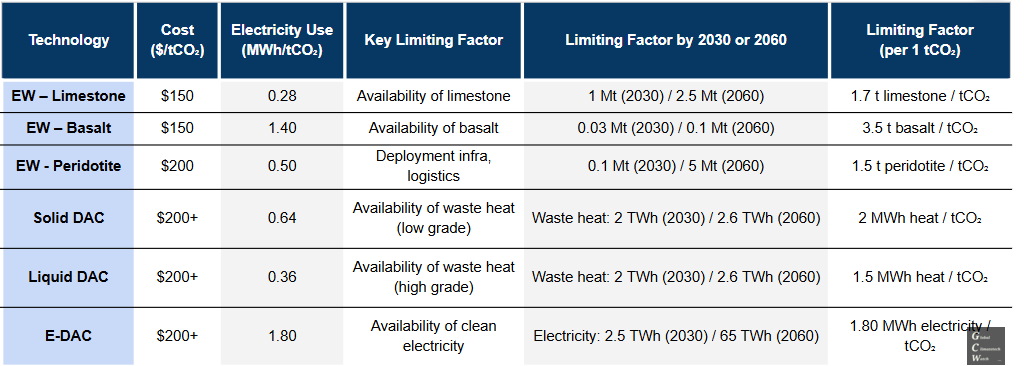
Now that we've mapped the GCC’s resource base, we apply a merit order framework to prioritize technology-based CDR options. This method ranks pathways based on:
Cost per ton of CO₂ removed
Electricity or energy intensity (MWh/tCO₂)
Primary limiting factor (e.g. heat, minerals, electricity, land access)
By aligning these criteria with realistic deployment limits in 2030 and 2060, we estimate the amount of CO₂ each pathway could feasibly remove under resource constraints.
1️⃣ Step 1: Define Key Parameters for Each Technology
2️⃣ Step 2: Allocate Electricity Based on Limiting Factors & Priority
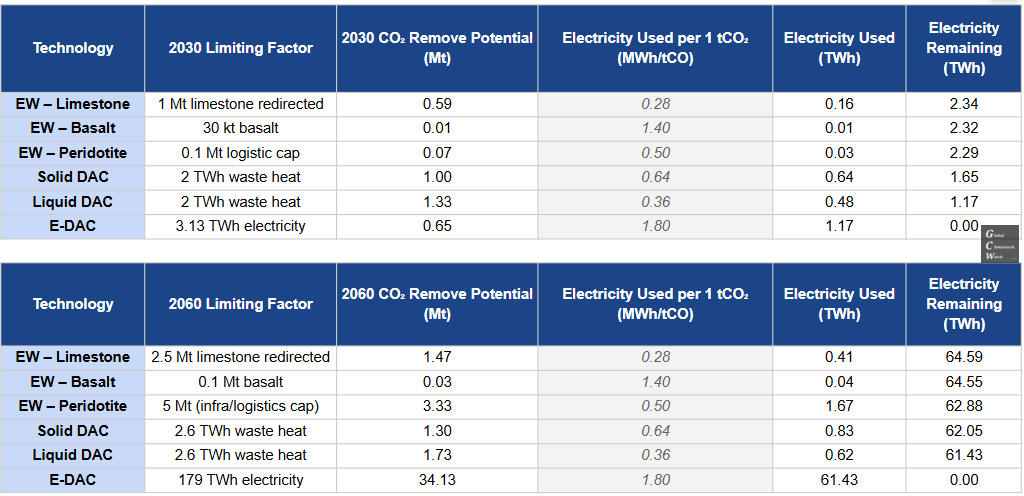
3️⃣ Step 3: Form “Merit Order“
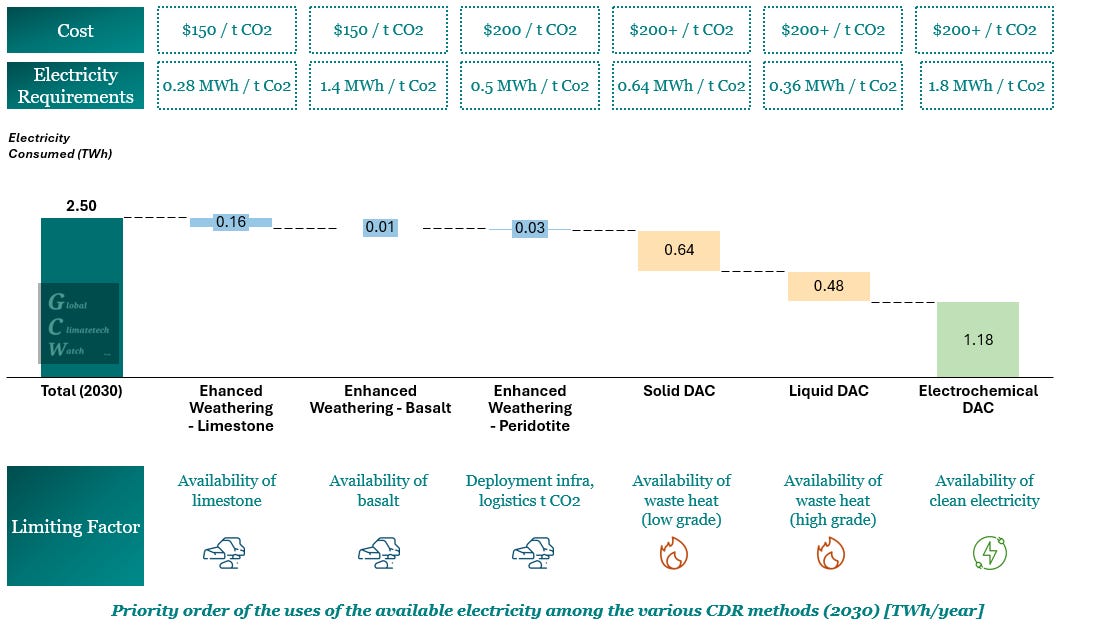
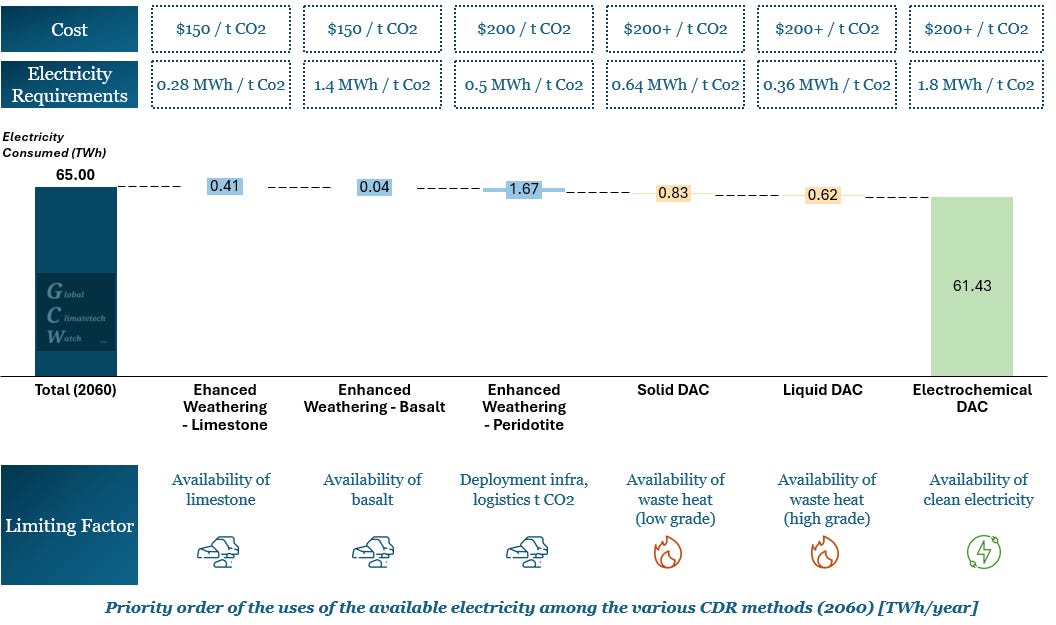
Of course, these estimates depend on evolving assumptions, regulatory developments, and deployment constraints. Based on the current analysis, the GCC could achieve approximately 3.7 MtCO₂/year of CDR potential by 2030, and up to 42 MtCO₂/year by 2060, primarily limited by the availability of clean electricity, waste heat, and mineral feedstocks.
In conclusion, the estimated tech-based CDR potential in the GCC based on limiting factors (See figure 5 and 6) :
2030: ~3.7 MtCO₂/year
2060: ~42 MtCO₂/year
Disclaimer: These figures are indicative and based on rough current assumptions; actual realizable potential will depend on technology readiness, infrastructure buildout, and regulatory progress. Validation under local conditions is essential.

Utilization
Utilization in the GCC remains very nascent, but the following represent potential future pathways.
1. Carbonate Mineralization (e.g., Concrete, Aggregates)
Pathway: CO₂ reacts with alkaline materials (e.g., cement kiln dust, slag, brine minerals) to form stable carbonates used in building products.
Relevant sectors: Cement, desalination, construction
Limiting factors include: Feedstock availability of reactive alkaline materials, redesign for existing plants, costs and incentives etc.
2. Stable Carbon-Bearing Products (e.g., Biochar, Polymers)
Biochar: Produced from biomass pyrolysis and applied to soil for long-term carbon storage
Already included in biomass section (~2.6 MtCO₂/year max)
Limited factors include: except biomass capacity, end use is limited in terms of markets for biochar in agriculture or construction
Summary of feasibility by paths
BECCS
Feasibility: Moderate to Low (under current conditions)
Opportunities: Up to 20 Mt/year of sustainable biomass—mainly MSW and animal waste—could support BECCS via combustion or anaerobic digestion. Existing waste-to-energy plants and digesters offer integration points.
Constraints: Biomass supply is limited and fragmented, with priority uses (e.g., fertilizer, recycling). Most biomass types in the GCC are low in energy content or high in moisture, making combustion less efficient. No mature logistics or processing infrastructure for biomass collection and conversion.
DACCS
Feasibility: Moderate to high, depending on siting and technology choice.
Energy: Ample clean energy potential and abundant waste heat (>100°C) from refining, petrochemicals, and power plants offer strong co-location opportunities.
Technology Fit:
Solid sorbent DACCS (e.g., Climeworks) can leverage high-grade waste heat, ideal for GCC’s industrial clusters.
Liquid solvent DACCS (e.g., Carbon Engineering) requires low-grade heat and significant water, which may be constrained unless paired with desalination.
Emerging hybrid systems (e.g., Heirloom, Sustaera) offer modularity, with some being water-positive, making them suitable for inland or arid zones.
Constraints: High capital costs, limited early-stage government incentives, and need for robust MRV frameworks.
Direct Ocean Removal
Feasibility: Moderate (with potential for innovation-driven scale-up)
Opportunities: The GCC’s long coastline, widespread desalination, and mineral-rich brines position it well for electrochemical DOC and brine-based carbon removal.
Constraints: High salinity and temperature may reduce process efficiency and CO₂ permanence. Most DOC technologies remain early-stage (TRL 4–6). Key gaps include electricity stability, brine protocols, MRV, and marine policy. Public and ecological concerns may slow deployment.
Enhanced Weathering & Ocean Alkalinity
Feasibility: High long-term potential with key execution barriers
Opportunities: The GCC has abundant alkaline minerals (limestone, basalt, peridotite) and industrial byproducts, supported by mature mining and cement sectors in KSA, UAE, and Oman. Coastal access and widespread desalination infrastructure enable integration of ocean alkalinity enhancement in UAE, Oman, and Qatar.
Constraints: Major challenges include regulatory gaps, limited regional data on dissolution rates and ecosystem impacts, and high logistics costs. MRV systems for both land and ocean applications are still lacking locally and underdeveloped globally.
Author’s Word: There has been limited research conducted in this space overall—let alone studies focused specifically on the Middle East. My analysis approaches the topic from an academic lens, but given the current state of knowledge and data availability, much of it remains at a surface level. I'm especially grateful for Carbon Gap’s Carbon Removal Readiness Assessment Initiative, which provided valuable methodological frameworks that I was able to reference and adapt throughout this exercise.
We now conclude our assessment of technology-based CDR potential and feasibility in the GCC. While the analysis highlights promising pathways and potential capacity, it is important to reiterate that all estimates are subject to significant assumptions around infrastructure readiness, policy evolution, and resource accessibility. Rather than shifting immediately to nature-based solutions, the next phase of my Middle East CDR series will focus on the enabling environment—exploring how policy frameworks, market design, and financing models can accelerate high-integrity CDR deployment in the region.
👐 Stay tuned—and if you're working in this space or simply curious, I’d love to hear your thoughts. Always open for a chat or exchange of ideas—please feel free to reach out!
Source:
Carbon Gap - Carbon Removal Readiness Assessment Initiative